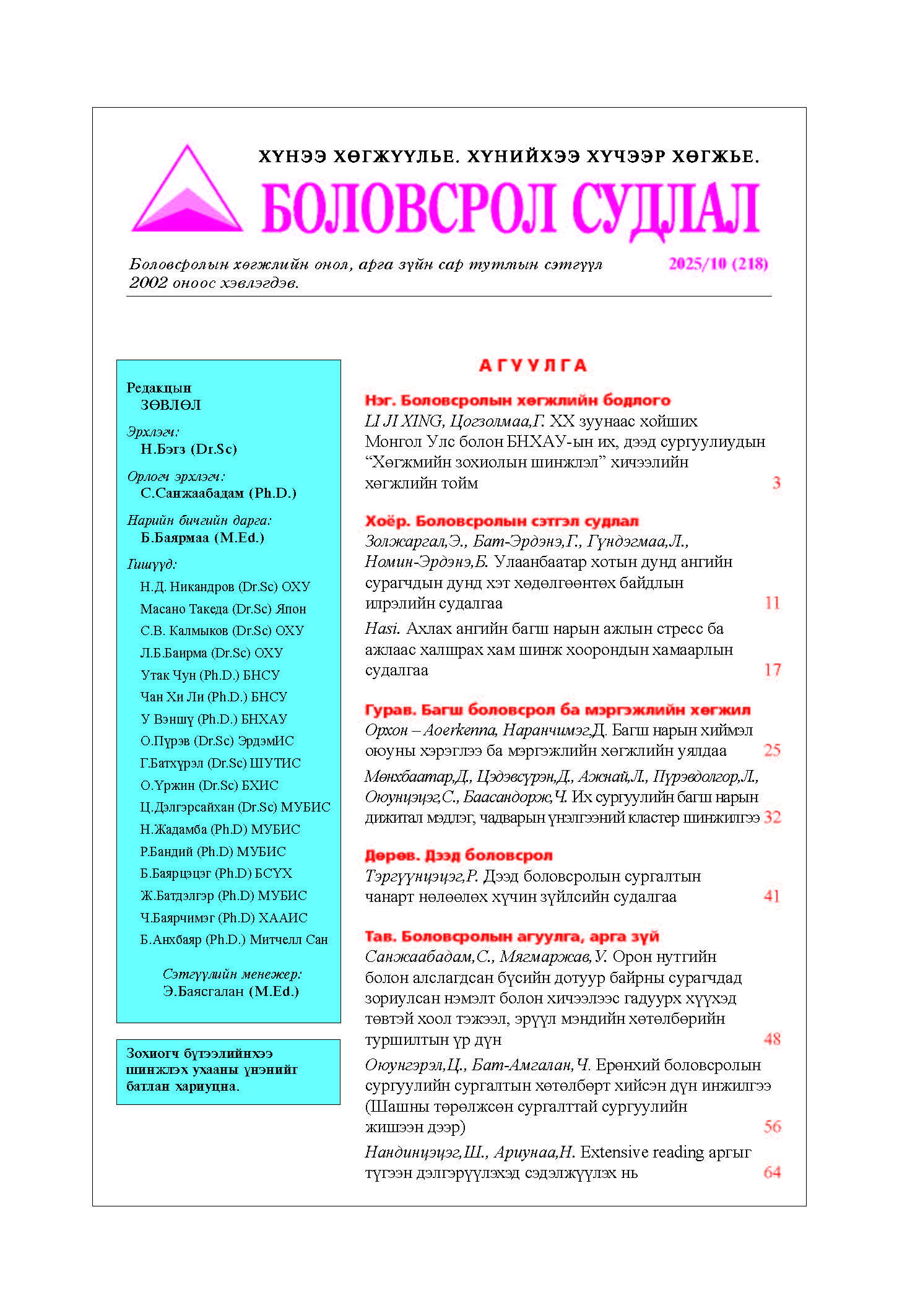
The Interrelation between Teachers’ Use of Artificial Intelligence and Professional Development
DOI:
https://doi.org/10.65168/bs.218-4Keywords:
Artificial Intelligence, Teachers’ Professional Development, Subject Area, Technical familiarityAbstract
This study investigates the professional development attitudes of natural science teachers regarding the use of Artificial Intelligence (AI) in education. It specifically examines how subject area and the level of teachers’ technical familiarity influence these attitudes in a systematic manner. A total of 316 teachers participated in the study, of whom 51 were natural science teachers. A five-point Likert-scale questionnaire was used, covering the use of AI tools, professional interest, and cognitive understanding. The data were analyzed using t-tests, chi-square tests, K-means clustering, and TPI-AI index analysis. The findings indicate that natural science teachers tend to use AI tools more effectively and show clear advantages in teaching methods, willingness to participate in training, and professional attitudes. Furthermore, teachers familiar with AI were more critical and attentive to ethical issues, suggesting that their attitudes are more advanced. This study extends the theoretical framework of technology acceptance in education within the context of TPACK and the diffusion of innovations theory, providing evidence-based support for developing AI training policies targeted at natural science teachers.
References
Davis, F. D. (1989). Perceived usefulness, perceived ease of use, and user acceptance of information technology. MIS Quarterly, 13(3), 319–340.
Holmes, W., Bialik, M., & Fadel, C. (2022). Artificial intelligence in education: Promises and implications for teaching and learning. OECD Publishing.
Lin, C.-H., Chen, H., & Liu, E. Z.-F. (2020). Exploring science teachers’ perceptions and practices of AI-enhanced instruction. Computers & Education, 148, 103808. https://doi.org/10.1016/j.compedu.2019.103808
Mishra, P., & Koehler, M. J. (2006). Technological pedagogical content knowledge: A framework for teacher knowledge. Teachers College Record, 108(6), 1017–1054. https://doi.org/10.1111/j.1467-9620.2006.00684.x
OECD. (2021). Teachers and leaders in AI-powered learning environments. OECD Publishing. https://www.oecd.org/education/teachers-and-leaders-in-AI-learning.pdf
Rogers, E. M. (2003). Diffusion of innovations (5th ed.). Free Press.
Tang, Y., Wang, L., & He, X. (2022). Understanding STEM teachers’ adoption of AI tools: A mixed-method study. Computers & Education, 186, 104531.
UNESCO. (2022). AI and the futures of learning. https://unesdoc.unesco.org/ark:/48223/pf0000377073
Venkatesh, V., Morris, M. G., Davis, G. B., & Davis, F. D. (2003). User acceptance of information technology: Toward a unified view. MIS Quarterly, 27(3), 425–478.
Zhang, Q., & Zheng, Y. (2021). Challenges in AI integration in science teaching: A Chinese perspective. Education and Information Technologies, 26(5), 5777–5796. https://doi.org/10.1007/s10639-021-10562-9